Posts

Art-fair fatigue 1: Basel
Image
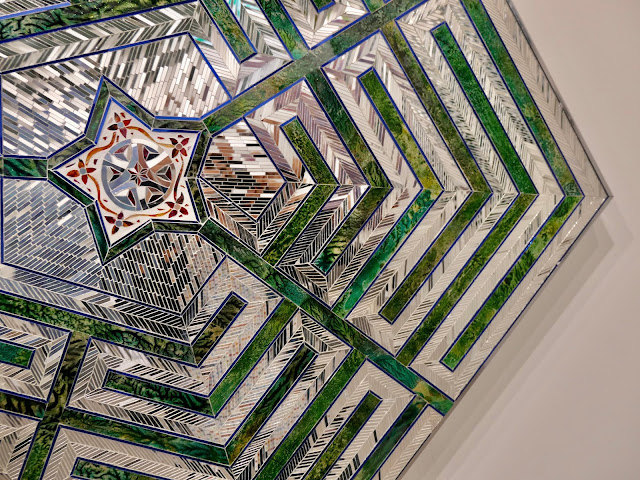
I don't usually 'do' international art fairs. I don't have enough black clothes for a start. But this year, as Tehran gallery Dastan was presenting a solo show of Mamali Shafahi's recent flocked reliefs, Heirloom Velvet , I took a week out of my summer holidays in Greece to go, for the first time, to Art Basel and Liste. I don't really feel at home in these events, with their VIP cards, air-kissing and cocktail parties, and Basel itself is otherwise a dull city, albeit an expensive one. But I must say the main fair, Art Basel itself, was spectacular. People I met there said it looked as if the galleries, post-Covid, were pulling all the stops out to show their very best works, and for once it seemed to me as if, in the huge central exhibition halls (it took me four-and-a-half hours to go round once ), there was hardly anything actually bad. Liste is a different affair, where less fancy galleries can show edgier (and cheaper) work in grungier surroundings. There ...

Growths of the Earth: Louis Fratino at Ciaccia Levi, Paris

Image
The first time I saw any work by Louis Fratino was nearly four years ago, when Antoine Lévi was showing some at Paris Internationale, the 'emerging art fair' that usually takes place at the same time as the 'posher' FIAC. I've often regretted I didn't buy the little Man on a Swing that caught my eye at the time. The one that got away: Man on a Swing Since then, I've visited Antoine Lévi's other exhibitions of Fratino's work, and bought a couple of pastel drawings. His pastels, paintings, drawings and even ceramics often visibly feature scenes from gay life, including explicitly sexual ones, but they are generally quiet and domestic in tone, a restful change from aggressive, hectoring, 'Spartist' contemporary art. You never get the feeling you're being beaten into submission with insistent identity politics. Today I went to see Growths of the Earth , Fratino's latest solo show at what's now Ciaccia Levi Paris. It was interesting t...

Clafoutis: sweet batter pudding with fruit

Image
This is the clafoutis straight out of the oven, before being sprinkled with sugar Clafoutis , originally from the Limousin region, is traditionally a black-cherry batter pudding, but people use the same simple technique to make it with various kinds of fruit*. What makes it especially easy is that there's no pastry case: clafoutis is basically sweet Yorkshire pudding with fruit, a toad-in-the-hole with fruit where the sausages would usually be. I do make it with cherries when they're in season, though in Paris cherries with any flavour aren't easy to find and if you find them you'll pay through the nose. I also make it with apricots, or in winter, pears. But this weekend a friend had given me a bunch of garden rhubarb, a fruit I can't resist, so I used that. Typically, you need about 700 or 800g of fruit. Begin early by cutting the rhubarb into chunks and mixing it, in a bowl, with 50g of sugar. I used demerara this time. I also added a couple of tablespoons of va...

Pinault Collection at the newly-reopened Bourse de Commerce

Image
A few days ago, I went to see the Pinault Collection's opening exhibition at the newly-renovated and reopened Bourse de Commerce. It was good to see that, for this opening exhibition - actually called Ouverture - the curators didn't just go for a massive show of billionaire purchasing-power: big, glossy, hugely expensive, boring works that look like they were made specially for sale to tycoons. There was perhaps some of that - I really don't get Bertrand Lavier, who filled the ground-floor glass cases, or for that matter Martial Raysse, who opens the whole show with a big painting just inside the entrance. But the upstairs selection mixes art-world stars with young artists just starting out and others somewhere in-between, not always to the youngsters' advantage. As an example, Luc Tuymans (another one whose fame is beyond my understanding) is shown with Miriam Cahn, a Swiss artist, and Antonio Obá, a Brazilian born in 1983. Urs Fischer's monumental installation, ...

Persian manuscripts in the Bodleian Library in Oxford

Image
A friend who keeps a sharp eye out for this kind of thing just sent me a YouTube playlist of apparently new videos by the Bodleian Library about some aspects of their collection of Persian manuscripts. They are brief, and leave you wishing they were longer. Digital Bodleian has a section on Persian manuscripts, which explains: The Bodleian acquired its first Persian manuscripts in 1602, the year it opened. These included a history of Gīlān – a province in western Iran - and a poetical work. The collections of Laud and Pococke contained a small number of Persian items, but it was with the collections of John and Thomas Greaves that the first Persian manuscripts of note entered the Library. MS. Greaves 1 (binding digitized only), a copy of Jāmī’s poem Yūsuf and Zulaykhā is prized for its beautiful lacquered binding and illustrations. John Greaves also made use of his copy of the Star Tables of Ulugh Beg – MS. Greaves 5 (sample only) – to publish his own astronomical and geographical o...

Amir Kamand, 'ALIENS vs GORILLAS' at Dastan's Basement, Tehran

Image
Installation view at Aliens vs Gorillas . All photos by Matin Jameie for Dastan. Another exhibition that opened up in the last couple of weeks, after Covid restrictions were eased, at Dastan in Tehran is Aliens and Gorillas , a solo show by Amir Kamand, curated by Mamali Shafahi. Amir Kamand, born in Tehran in 1960, is a sculptor now working mainly in polychrome wood. During his former career in plastic injection molding, metal machining and lathing, he was introduced to the use of wax and started to make sculptures with it, but soon decided that wood was a superior material. His works - colourful, vibrant and frequently funny - combine elements drawn from his own experience (e.g. as a former skier and boxer) and subconscious with references to icons of both western and oriental pop culture, cinema, poetry and literature. They have featured in three Annual Outsider Exhibitions and at Balice Hertling in Paris, and more recently in a large-scale solo installation at the Palais de Tokyo,...

'EPIC IRAN' at the Victoria and Albert Museum (V&A) in London

Image
Qaran Unhorses Barman, from the Shahnameh of Shah Tahmasp   ' Epic Iran explores 5,000 years of Iranian art, design and culture, bringing together over 300 objects from ancient, Islamic and contemporary Iran'. So runs a text on the V&A's dedicated exhibition website. Having seen the exhibition (which, Covid oblige , opened three months late) the other day, I wondered how many (or few) other countries could be the object of a show spanning 5,000 years of artistic production. The concept is ambitious, to say the least. While the press - or at least, the numerous online articles I've managed to find - has been unanimously enthusiastic, I'd be interested to know what impact this show has had on people with little or no prior knowledge or experience of Iran and its culture (or more accurately, cultures, with an 's'), its history and its present, including its buzzing contemporary art scene . I personally found the pre-Islamic sections, displaying some magni...